The Thing in the Bed

Image by Marisa Bruno

When my son was young, something happened in the night that we never discuss.

I don’t know if he remembers it. Some days, I’m not even sure it really happened.

But when it’s late at night and I can’t sleep—when I open my eyes to the lukewarm pressure of the dark—I remember what happened with a cold thrill of fear, and wonder if I’ll ever sleep soundly again.


Sebastian was a nervous child. I never knew why, but I always used to worry that it was somehow my fault.

I split up with his mother when he was six. There wasn’t much anger by then. We almost laughed at the state of it. I remember that we opened a bottle of wine and stayed up late to sort it all out.

But afterwards, I kept feeling like we’d ruined his whole childhood by failing to make the marriage work. Every time something went wrong in his life, I pictured the divorce as a dark figure standing over him. Like the opposite of a guardian angel, rubbing its hands with glee.

Maybe I’m being too hard on myself. That’s just my personality. My least favourite song is the one that goes non, je ne regrette rien, because the truth is I regret almost everything.


When Sebastian was ten, I still had to tuck him in at night. He had a superstitious terror of his own wardrobe and wouldn’t sleep unless I checked inside it for monsters. Even then, he had a lamp by his bed, and it had to stay on through the night.

To be fair, it was a scary wardrobe. A big solid unit, with a crest along the top that seemed to scowl at you.

It had once belonged to my mother-in-law. After she died, my ex thought that Sebastian would like it. He didn’t. I got him the Narnia books, hoping that he’d warm to it. He just got scared of witches.

By this point, I was starting to worry that he wasn’t as brave as the other boys in his school year. And to be honest, that bothered me. But I could sympathise, too. If there’s one thing that gives me goosebumps, it’s the thought of the supernatural. Even as an adult, I’ve been known to hurry out of a dark room, if I go in there alone and suddenly get the willies.

The funny thing is, apart from that, I like to think I’m quite brave. For instance: after the divorce, I took up free climbing. Every bank holiday, I drove to Land’s End or Malham Cove, just to see how high I could get without any gear. I was quite happy with my fingers and toes on the rockface, and nothing but fresh air under my feet.

Before Sebastian was born, I even passed selection for 4 Para, which is the reserve unit of the airborne infantry. I don’t want to overegg it because I didn’t deploy, so I’ll never know if I had it in me to be a soldier, but signing up for the reserves, and jumping out of planes, aren’t the actions of a nervous man.

Even so: if I’m alone at night and there’s a crack in the curtains, and I rise from my chair to draw them, I don’t like looking at the dark beyond, for fear of what I’ll see.


As part of my army training, I did a two week course in Catterick Garrison, which is an army town in Yorkshire. I bedded down with the other trainees in Helles Barracks. We were quite a diverse bunch. There was a mechanic from Glasgow, whose name I forget; a mature student called Ben, who sat there reading The Art of War and droning on about Tai Chi; and a placid Welshman who never said much. When he did speak, he just seemed faintly bemused. Like he’d wandered in by mistake, and didn’t understand why people were shouting orders at him, or making him run around in fields.

Then there was Jim. Jim was older than the rest of us. I forget the maximum age for reserves, but I know he was very close to it. Despite his advanced years, he was clearly the fittest of the group. He had staring blue eyes, visible veins on his temples, and not a pound of fat on his body. He was obsessed with getting his resting heart rate as low as possible, and he had this off-putting habit of feeling his throat to check his pulse. I remember Ben saying that he wouldn’t be happy with his resting heart rate until he was clinically dead.

He came from a place that he called “Kersal”. At the time, I’d never heard of it. He made it sound like the Transylvania of the northwest. A spooky little corner of Greater Manchester, where gothic scenes played out in council flats, or on the banks of the River Irwell.

“I bet it was great in summer,” said Ben—meaning the river.

Jim smiled.

“Me mum wouldn’t let us anywhere near it,” he said. “We weren’t even allowed to go past the soapworks. She reckoned that river was haunted.”

“By what?”

“She called ’em ‘geggers’.”

“Ghosts?”

Jim shook his head.

“More like fairies. If one took a shine to you, it followed you home and gobbled you up in bed. Then it took your place. No one would know it wasn’t you.”

“Why did they do that?”

Jim felt his neck, counting the heartbeats.

“God knows,” he said. “Ask me mum.”

I shuddered in my bunk. Obviously, I didn’t believe in “geggers”—or rather, my brain didn’t believe in them—but it’s funny what you feel in your bones to be true, when it’s late at night and the goosebumps come. And the goosebumps were right, as I’ll soon explain.


I met my ex in Liverpool, at a pub called The Hole in the Wall. It’s tucked away in a long narrow street called Hackins Hey, and it’s meant to be the oldest pub in the city. It’s out of the way, but I’d heard it was there and made a special trip to see it, when I was on a job in St Helens.

The Hole in the Wall was built in the 1720s. I’m no expert but it seemed a lot older. Almost Tudor, in fact. The timbers were painted black. The first floor windows had cast iron lattices. It was grubby and charming at the same time.

Inside were dark wooden panels, gleaming brass fittings and a burning fire. There were room dividers with stained glass windows. Back then, you could still smoke in bars, so the air was thick with blue-grey fumes.

Louise was standing by the bar, rummaging in her handbag. She had gleaming red hair and matching lips. I was army-fit in those days and cocky with it, so I marched right up to the bar and paid for her drink, without even asking if she wanted me to.

“Thanks,” she said warily. “Who are you?”

“Paul. You?”

“Louise.”

I asked if she was from Manchester. She had that peculiar accent, like she was talking through her nostrils.

“Not quite,” she said with a smile. “Salford.”

“Anywhere near Old Trafford?”

She shook her head.

North Salford,” she clarified. “Place called Kersal.”

I was surprised. I hadn’t quite realised that Kersal was part of Salford.

“I heard there’s a haunted river there,” I said. “Is that true?”

She gave me a withering look.

“It’s not true true, is it? Nowhere’s haunted. Not really. But we used to tell stories. There was a witch there called Wet Ethel.”

I laughed at at the image.

“Wet Ethel!” I said. “And what about—geggers?”

She looked at me blankly.

“Geggers?”

I shrugged and finished my lager. I was starting to wonder if Jim had been pulling our legs.

“Just something I heard about. It doesn’t matter.”

I offered to buy her another drink, but she insisted on getting the next round. It turned out she worked there and had only just finished her shift. We were still propping up the bar when her colleague rang last orders.

Two years later, she was pregnant and we were engaged.

We moved to Kersal to be close to her parents. I bought a house on Castlewood Road, just round the corner from the soap factory. It was the same one which, decades earlier, had marked the end of Jim’s permitted route, as decreed by his superstitious mum.

Beyond that was Agecroft Bridge, which carried cars across the Irwell.

Fate had led us to the haunted river.


When Sebastian was ten, I took him for a walk in Drinkwater Park.

We were following the river. The water’s meant to be filthy, but it’s a nice enough walk on a sunny day—and it was a sunny day. The air was almost swampy. A faint rotten smell kept wafting from the river. The sky looked raw, like a peeled blister.

I paused when I saw a giant drainpipe. It was sticking out from the far side of the river, spewing water from god-knows-where. It made a thunderous sound as it struck the surface, turning the river to white rapids.

“Look at that pipe!” I told Sebastian. “Look at all that water! Where do you think it comes from?”

He glanced across the river and his eyes widened.

“There’s someone in it,” he said in surprise.

“In the pipe?”

“Yeah.”

I turned to look again. All I could see was water coming out of it.

“Don’t be daft,” I said gently. “It’s empty. See?”

He was becoming visibly agitated, so I stopped trying to pique his interest. When we resumed our walk, he kept looking nervously around him. Then he slowed to a halt and just stood there, staring into the distance.

I started to lose patience.

“What?” I said brusquely.

He pointed down the river.

“There’s someone under that bridge,” he said fearfully.

“Where?”

“You just missed him. He’s hiding.”

I wasn’t convinced that Sebastian had seen anyone, but nor was I sure that he hadn’t. Older children often loitered in the area. Also, we weren’t far from Forest Bank Prison, which was right on the banks of the river. In the worst case scenario, it could have been a fugitive, trying to evade detection.

“What was he doing, when you saw him?”

“He wasn’t doing anything.”

“Ignore him, then. Come on.”

We walked past the bridge in silence. Once it was behind us, I risked a backwards glance over my shoulder. I couldn’t see anyone under it, but I’m not sure I would have done, from that angle.

The river shone like liquid fire, dazzling my eyes. And then—wait!—was that a dark figure—hunched over in the glare, like a goblin?

As soon as I saw it, it was gone. Was the light playing tricks on my eyes? I doubt I’ll ever know.


Some nights later, Sebastian woke me twice because of tapping on the bedroom window, which scared him.

It was a windy night and we had a tree in the garden. A large apple tree, which gave a yearly harvest of small inedible fruit. The branches must have been knocking the glass. The next day, I got a lopper from the shed and leaned right out of his bedroom window, cutting the branches down to size.

When bedtime came, I sent him to brush his teeth and promised to meet him upstairs, so I could check for monsters and tuck him in as always. Before I did, the phone rang. It was his mum, having some kind of drama with the bank. After a while of trying to help her untangle it, I promised to ring her back and got off the line.

When I went upstairs, the whole house was quiet. I wondered if he was already sleeping. I opened the door very slowly, just in case he was.

He wasn’t. His little white eyes shone in the dark. For some reason, his bedside lamp was off.

“Sorry,” I said softly. “That was your mum. You know what she’s like.”

When he didn’t respond, I went to his bedside and stroked his hair. It was fine and red, like his mother’s. I could feel heat and sweat coming off it, and wondered if he was coming down with something.

“I thought you might be sleeping,” I said. “No luck?”

He shook his head.

“Do you want me to check the wardrobe?”

He shook it again, which surprised me.

“No?”

He had the duvet pulled up to his nose. I looked at the wardrobe. In the dark, it was barely visible.

“What about the lamp?” I said. “Do you want me to turn it on?”

He didn’t answer, so I reached across the bed and pressed the button. With a sharp click, the wardrobe appeared in a pool of light.

The doors were ajar, which was strange. A vertical band of darkness ran between them, about as wide as my thumb is long.

In that narrow strip of gloom, I thought I saw a flicker of movement. One of the doors wobbled on its hinges.

A soft noise came from within, like a little gasp of air.

My mind raced but resisted horror. Surely, I thought—surely we’d let an animal into the house?

Then I remembered the bedroom window. I’d left it open when I’d finished lopping branches off the tree. Even now, the cheap curtains billowed by the bed, filling with air and slowly exhaling it. Synthetic fibres glowed in the lamplight.

It’s just an animal, I told myself. Probably a cat. That’s all.

“Stay there,” I told Sebastian.

I went to the wardrobe and opened the doors, bracing myself for a startled cat to shoot out of it.

It wasn’t a cat.

Hugging his knees on the sock drawers—cowering among his own school shirts—was Sebastian, my son.

He looked up at me in terror. My mind reeled as I heard his words:

I don’t know who that is in my bed.”

As if in a dream, I turned to see.

The thing in the bed that looked like my son was sitting up now—grinning right at me.

It wasn’t a perfect copy. The smile was too wide. Cheeks stuck out to make room for it. Five inches of grinning teeth, gleaming in the lamplight.

“Ge-e-e-egh!” it croaked—clacking its horrible jaws at me.

The room span, and I’m not ashamed to say I fainted.


Some time later I woke with a start.

It was dawn by then. The birds seemed aggressively loud. Through the wide-open window, liquid light came flooding in.

Sebastian was curled up behind me, still in the wardrobe. He was snoring softly with his hands on his face. I moved them gently to check his features. They were perfectly normal.

“Sebastian?”

He whimpered softly but didn’t wake. I picked him up and managed to carry him to my room. He woke briefly on the landing and stiffened with fear, so I held him tight and shushed him.

“You had a nightmare,” I lied.

When we rose at noon, he showed no signs of remembering—but nor did he ask why he’d slept in my bed—so I guessed that he remembered something. Maybe just being carried. A vague recollection of a night terror.

I knew that I’d come face-to-face with a “gegger” that night, so Jim’s words came back to haunt me: “If one took a shine to you, it followed you home and gobbled you up in bed. Then it took your place...

I kept glancing at Sebastian, looking for clues that something was amiss. Was it my real son? Or a changeling? In the days that followed, I asked him questions, checking for things that no one else would’ve known. I came to the conclusion that, if it wasn’t him, it was doing a damn good impression.

But that left a lingering mystery: why didn’t the gegger take him when it had chance?

The terrible thing is, I’ll never know what happened when I was out cold. All I can say for sure is, when I fainted, I collapsed right in front of my son. Maybe that was enough to discourage the gegger? It would have needed to climb over me to get at Sebastian. Was that enough of a deterrent?

I guess so. And yet…

Here’s what bothers me, even now. After the events of that terrible night, my son no longer needed me to tuck him in, or check inside the wardrobe for monsters. In that regard at least, he was a changed boy.

I like to think that, somewhere in his brain, his subconscious knows what happened that night, and the experience toughened him up. It’s a nice idea, because the alternative is unthinkable.

I have a recurring dream, or rather nightmare, and hope to God it won’t come true. I dream that I’m an old man, lying at last on my deathbed. Sebastian sits beside me. I can hear the peep—peep—peep of my heartbeat slowing down on the monitor.

When the time comes for me to die, he takes my hand and leans across the bed. I look up at his face. When I do, he smiles a terrible smile that’s far too big, and I know the monster got him after all.


Ellis Reed, 08/03/2024

(Author’s note: this story took some inspiration from a two sentence horror story by Juan J Ruiz.)
Deep Summer Magic

Illustration by Marisa Bruno.
Image by Marisa Bruno.

“Deep Summer Magic” is also available as a free audiobook, narrated by Nick Denton.


It’s strange how long that summer seemed. We were fourteen that year. The days buzzed around us like a swarm of midges. The long holiday stretched out before us, as bright and as wide as the River Nile.

There was a gang of us who knocked around together. We weren’t popular at school, but—with the possible exception of Tim—were far from the bottom of that brutal pecking order (Tim had the distinction of being very large but very soft, with a lisping voice that hadn’t really broken). Aside from Tim, there was Jon Jones, who was pretty tough; “Mandy”, or Tom Manders; and finally me. We’d bonded over a love of electric guitars, 80s horror movies, and video games like Mortal Kombat.

One day in August, there was a heatwave, so we decided to camp near the river in the park. I don’t remember who said it first. I don’t even think it was our idea. It was simply there, humming in the hot air, till someone gave it voice.

I remember I’d been lying in bed some nights before. The window was open. The air was warm and almost still. Out in the dark, something made a soft knocking sound, like coconuts or bits of wood. I couldn’t tell if it was a nearby tapping or a distant pounding, but whatever it was seemed to call me from my bed, urging me to rise and rejoice.

I was in the fairyland at the edge of sleep. As my thoughts turned to mush, I pictured a girl running through the dark valley, banging two sticks. Come and play, she seemed to call. Come and play. The river ran beside her like a friend. Then I was asleep.

The next day, we gathered at the top of Moor Lane and hurtled down it on our bikes. Halfway to Kersal Vale, one of us cried, “Let’s go camping!” Maybe it was me.

None of us had tents but it didn’t seem to matter. We’d been sleeping with our windows open and the covers off, so were just as happy to kip in our clothes on a bit of soft grass. The plan was, Tim and I would tell our parents that Mandy was having a sleepover. His mum was dead and his dad was in prison, so he lived with an adult brother in Kersal Vale. “Big Mandy” was far from neglectful, but he was a brother rather than a dad, and more than happy to cover for us.

Jon didn’t need to make arrangements. His parents were spending the night in Burnley because his grandma was starting to struggle. They’d been doing it more and more since she’d had her mini stroke. When school started, Jon wasn’t coming back, because they were getting a place in Accrington. On the last day of term, he even got us to sign his shirt, like the fifth-years do when they’re leaving forever.

Just as the sun was setting, we gathered at the bottom of Rainsough Brow, on the corner of the junction with the mini roundabout. There were no mobile phones then, so we’d planned the rendezvous on our landlines—which, looking back, seems as quaint as using walky-talkies, or whispering into tin cans. These were the days when you knew your friends’ numbers off by heart, because that was the only way to talk after school—short of going round in person—and you had to dial the numbers by hand.

“Right,” said Jon. “Did you all bring torches?”

We had. Poor Tim’s was more of a toy than a proper torch, so we spent a good few minutes taking the piss out of him.

“And what about food?”

We opened our rucksacks for inspection. I’d made tuna paste sandwiches and wrapped them badly in clingfilm. I’d also nicked some Mars Bars from the cupboard and filled a bottle with Ribena. Tim had brought literally nothing but a twin-pack of Bourbon biscuits, which cost about 20p from Tesco, so we jeered at him again. Mandy had three different types of cake bar, and—this also got some jeers—a single bag of prawn cocktail crisps, which had popped in transit.

“Good,” said Jon.

Then he smiled and unzipped his bag. Instead of food he had three big bottles of cider. He also had two packets of cigarettes, though one was open and looked a bit crushed.

Mandy whistled appreciatively. Tim looked around nervously, as if we might get arrested. Then we zipped our bags up and made our way to the nearby park.

The park follows the river, all the way to Whitefield at least. It’s funny how much green there is, so close to the greys of suburbia. You can walk all the way from Rainsough to the big Tesco in Prestwich, and it’s river almost all the way. Within minutes of leaving the mini roundabout, it was like we were in the middle of nowhere.

“Funny how close we are to the country,” said Tim.

Jon snorted.

“It’s not the country, you pillock. It’s Drinkwater Park.”

“I know. But it’s like we’re miles from anywhere.”

“Yeah. Thank F░░░ for all them Bourbon biscuits, eh?”

We laughed but knew exactly what Tim meant. We were following the river north and could have been anywhere on Earth. Water shone to the left of us, mixing colours from the sky with the faint green tinge of chlorophyll. The river made a soft liquid sound, lapping the grass that grew on its banks. Birds twittered in the dying light.

Before long we had to use our torches. We swung them in the dark, watching shadows lean in and then draw back. Our conversation dwindled, till all we could hear was the plop-plop-plopping of the river.

Then, once more, there came that strange knocking sound. It could have been soft and near or loud and far, but it made me shiver—in a nice way, I mean—like the thought of a coming birthday.

“What’s that sound?” I wondered.

They all knew what I meant.

“Dunno,” said Mandy. “But I like it.”

It was a strange thing to say, but I knew what he meant as well.

Later in life, it became important for me to work out exactly where we were that night. I know we hadn’t got far because we kept mucking around. At one point, we were chasing Tim, flashing torches in his eyes and trying to make him have a seizure. We stopped for sandwiches and some of the cake bars. I know we’d gone past the prison, because Jon made fun of Mandy’s dad—and I know there was a bridge, because Mandy did a piss off the side of it. We were a short way past the bridge, and that’s all I know for sure.

“It’s spooky at night,” said Mandy.

To lighten the mood, he shone his torch up his chin and did a manic laugh.

“Does anyone know any ghost stories?”

“Nah,” said Tim.

He was trying to sound blasé but I knew he was nervous. He was visibly relieved when Jon—the de facto leader of the gang—scoffed at the suggestion.

“It’s not a bloody cub camp,” he said. “Let’s have some cider and smoke these fags.”

He balanced his torch and got the bottles out. We passed them around, wincing at the sharp taste. Then he tried to light a cigarette, holding it over the lighter like a candle.

“You’ve got to put it in your mouth,” said Mandy.

Jon scowled.

“Does it matter?”

“Yeah. You’ve got to suck it. If you do it like that, you’re just toasting it.”

Jon tried it Mandy’s way. When it worked, he coughed out a cloud of smoke.

“Oh yeah,” he muttered.

He tried a second time and managed to get it down. It came out in a long shuddering breath, like he was on the verge of coughing again.

“Tastes pretty good,” he said, trying to save face—but it was a ridiculous thing to say—because it was a Lambert & Butler, rather than a Romeo y Julieta.

We all smoked except for Tim, who reminded us piously that “Gramps” had died of lung cancer. Jon pointed out—not unfairly—that “Gramps” had been eighty years old, and twenty stone if he weighed a ounce. All things considered, Gramps had had a pretty good innings.

Eventually, feeling a bit sick, we finished the cigarettes. Mandy checked his watch.

“It’s still early,” he said. “Should we carry on walking?”

“Nah,” said Jon. “We’ll end up at Tesco’s if we’re not careful.”

He turned his back to the river and shone his torch through the trees. We could hear the knocking again. It seemed to come from the other side.

“Let’s explore,” he decided.

We made our way through the dark trunks, snagging our jeans on brambles. Soon we were lost in a wild wood, glimpsing stars through the broken canopy.

“We’re nearly through,” said Tim.

Ahead of us was a dark building, blotting out the sky. Even in the moonlight, you couldn’t see much except for the size. We emerged from the trees and hurried over, shining our torches this way and that.

“Where are we?” I wondered.

Mandy shrugged.

“Dunno. Looks empty.”

It was a Georgian manor with tall sash windows. In the dark, they were bars of chocolate stood on end. Some of the panes were smashed. The house was made of brick but had a stone porch, with two pillars and a pediment.

I shone my torch around. Whatever it was, it didn’t seem real. Torches have a funny way of destabilising things. I think it’s the moving shadows. Ripples of chiaroscuro, spreading like a strange liquid.

“The door’s open,” I realised—shining my torch.

“We’re going in,” said Jon.

Tim looked at him in horror.

“Don’t be daft,” he begged. “It’s trespass!”

Mandy and I looked at each other. We had to pick a side. We didn’t want to go in the old house, but the alternative was joining a tragic faction led by Tim.

“We could call through the door,” said Mandy. “If no one answers—it’s probably safe to look around?”

I shrugged. It seemed like a fair compromise.

“Okay,” I agreed. “Do it.”

Jon marched up to the open door.

“Hello?” he called. “Hell-o?

No one stirred inside, so he took a deep breath.

“Scrubby-dubby-doo-oo-o!” he bellowed at the dark.

We burst out laughing. I can’t tell you what “scrubby-dubby-do” means, because it doesn’t mean anything. It was just something we liked to shout. Mostly at Tim, when he turned up in his dad’s old clothes, or a horrible pair of trainers.

Satisfied, we went inside. The laughter soon died on our lips. There’s something instantly sobering about an old building. A stark memento mori that can’t be put into words.

We found a long dark lobby, with evil-looking stairs that rose into gloom. Mud had been trodden inside, drying on the tiles in brittle shapes. Grey dust hovered in the air and stuck to the banister. There was a red carpet on the stairs, held in place with stair-rods—but the carpet had been eaten by moths, and the rods were discoloured with age.

“It’s not abandoned,” Tim realised.

“Of course it is,” said Jon. “Look around.”

“I know—but listen.

We did. It was clear from our faces that we couldn’t hear a thing. Then Mandy’s eyes widened.

“A clock,” he said. “I can hear it ticking. Right?”

“Exactly,” said Tim. “Someone’s been putting batteries in.”

I could hear it too. It was a deep tock, tock, like someone clicking their tongue at the top of the stairs. The sound of an antique.

“Or winding it up,” I pointed out.

Jon rolled his eyes.

“Well whoever it was, they’re not here now,” he said impatiently. “And we shouldn’t leave till we’ve seen upstairs. Come on.”

One by one we mounted the stairs. With every step we took, they groaned underfoot.

“These stairs are loud,” said Mandy. “Hope they don’t collapse!”

“It’s not the stairs,” said Jon. “Tim’s got creaky trainers.”

“Give it a rest,” Tim muttered.

At the top of the stairs we found a long dark hall. The landing wasn’t bad, but the bottom of the hall was a real mess.

“That ceiling’s going to fall,” I said glumly.

Down the ruined hall, doors stood in pairs, facing each other like soldiers. All were closed except one at the far end which was slightly ajar.

I probed the dark space between door and frame. I felt like I could push it open with the beam of light.

“Is this what’s ticking?” said Mandy behind me.

I turned. He was shining his torch at a grandfather clock.

“What’s the time?” I wondered.

“Dunno. It’s not right.”

He checked his own watch.

“Half ten,” he added.

Tim glanced at the clock.

“It’s not that,” he said. “It’s coming from over there.”

He waved down the hall.

“And I think I was wrong. I don’t think it is a clock. It’s the sound we heard outside. The weird knocking.”

I cupped my ear. I couldn’t tell if he was right or not.

“I actually heard it in bed,” said Mandy. “The knocking, I mean.”

“Me too,” I said.

“Me too,” Tim agreed.

Jon groaned and sat down.

“Me too,” he said. “Come on, let’s have another drink.”

Tim looked at him in surprise.

“Here? Are you kidding? Have you seen the state of it? We’re probably breathing all the spores in! Can’t we just go now?”

When no one answered, he shook his head in annoyance.

“Right,” he said bitterly. “I’ll see you outside then.”

He turned to leave. When he was halfway to the stairs, the knocking got faster and louder, making him pause.

Knock-knock-knock.

My skin crawled in a pleasant way. A small electric thrill. I suddenly knew how the ancients felt, when the shaman banged his trance-inducing drum.

Knock-knock-knock.

Jon sprang to his feet.

“It’s in that room,” he realised. “The one at the end. Someone’s mucking around.”

He took a step forward.

“Who’s there?” he called.

The knocking stopped abruptly.

“I am,” said a voice in the dark.

Tim jumped in fright, but the rest of us were just confused. It was the voice of a girl, coming from the room with the half-open door. The stranger thing was, the room wasn’t lit—so whatever she was doing, she did in the dark.

“What are you playing at?” said Jon.

“Banging sticks.”

She did it once for illustration. Knock!

“You were by the river,” said Jon.

“No.”

“Then how did we hear you, by the river?”

She laughed softly through the crack in the door. As she did, the end of the hall seemed visibly to darken. Liquid gloom was seeping out of there. It was like a cloud of octopus ink.

“How did you hear me in your beds?” she pointed out.

When we didn’t answer, she resumed her game. Knock, knock, knock.

“They’re special sticks,” she said through the door. “The sound they make is the heartbeat of the soil. The rhythm of the rain. Deep summer magic that only I know. The sound is heard where I wish it to be heard.”

Knock, knock, knock.

My heart soared. Suddenly, there was nothing to fear from the end of the hall. The dark was a friend and not a threat. The mould on the walls wasn’t squalid: it was the miracle of life, nourished by rain that remembered the sea. It was ripe and wholesome, like a field of wheat in summer.

“Come and play,” she called from the dark.

As if in a dream, we began to walk to the end of the hall.

I got there first but paused at the door, staring in a sort of trance. It was Jon, our glorious leader, who pushed his way past and shone a torch inside.

To this day, I can’t remember much about the room itself, except how dark it was. I dimly recall the black mould and maybe a window. That’s it. I couldn’t tell you if the room was big or small, furnished or bare. All I really remember is the girl.

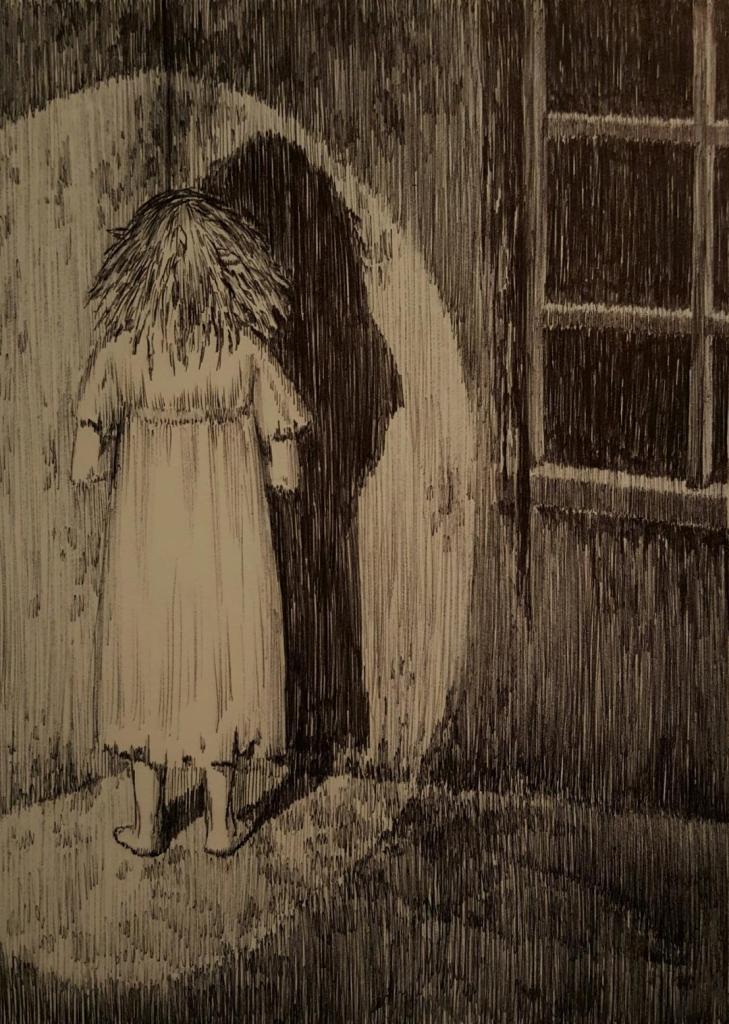
She was standing in the corner with her back to us. Her hair was full of twigs and dead leaves. She wore a long white gown and her feet were bare.

Knock, knock, knock, went the sticks in her hands.

She didn’t stop or turn round. With each percussive blow, her elbows twitched at her sides.

We looked at each other in pleasant confusion, then turned our gaze to the girl.

“Who are you?” Jon marvelled.

“The spirit of the woods,” she said. “You can stay with me forever in this house.”

“Then show us your face,” he urged.

“You don’t want to see it.”

He moved impatiently towards her.

“Yes we do.”

I don’t know how the spell was broken, but I know I wobbled as I stood there. Did we want to?

It was suddenly strange, rather than charming, for the girl to be standing with her back to us. I wondered what she was doing there at all. Before we’d brought our torches, she’d been waiting in the dark. Her bare arms were those of an old woman, even though she had the voice of a girl.

“Show us your face,” said Jon again—reaching out to grab her shoulder. I realised, with a sudden pang of dread, that I didn’t want to see it.

Tim was the first to bolt. Without a word, he turned and fled. Mandy and I followed him through the hall, all the way down the dark stairs. His thumping feet had stirred us from our trance.

Jon didn’t follow.

We heard a bloodcurdling scream behind us. It grew in volume as we exploded through the door and into the night. It followed us through the dark trees, all the way to the river.


We got split up in the dark but managed to find our separate ways home. I remember I came out of the park somewhere in Prestwich, then wandered aimlessly till I found Bury New Road.

In the days that followed, we talked by phone, speaking in low whispers so our parents didn’t hear. None of us could reach Jon. To this day, I have no idea what happened to him. Maybe his parents returned from Burnley to find him missing, but news never reached us, because he’d already left school. It does seem odd that the police wouldn’t speak to his friends, so I like to think he found his way home, and they moved to Accrington as planned.

Later in life, I tried to find him on social media. I never could.

Nor could I find that house again. As an adult, I viewed the whole park on Google Maps. As far as I could see, there was no Georgian manor.

One day, I returned on foot and tried to retrace my steps. Somewhere past the prison and the bridge, I turned my back to the river and went through the trees. After a while, I found the bare foundations of a long-gone building.

I did a bit of reading online. I believe they were the remains of Irwell House. According to Wikipedia, “the house caught fire during a civil defence exercise in 1958 and was demolished some years later. The foundations and the first course of stones were left in place and are still visible today.”

I’ve since found a painting of Irwell House, so I know it was a Georgian manor with sash windows. The doorway was stone, with two pillars and a pediment. It came down years ago, before I was born. The foundations are wild with long grass. Make of that what you will.

I don’t know who the girl was, but I know she isn’t human. Maybe she never was—but she’s out there, somewhere. Even now, she haunts a dark hall in a house that isn’t there, calling children in the night.

When summer comes, I leave a TV on in my bedroom, for fear I’ll hear that knocking again.

One thing remains to be said. When I left Kersal High for the last time, I got the other pupils to sign my school shirt. That was the tradition.

Years later, I found it in the loft and read the messages. One of them surprised me.

I’m still here, someone had written. Come and play. Jon.

I hope it was Tim or Mandy trying to be funny, but in my heart of hearts I know it wasn’t.


Ellis Reed, 19/04/2020