The Thing in the Bed

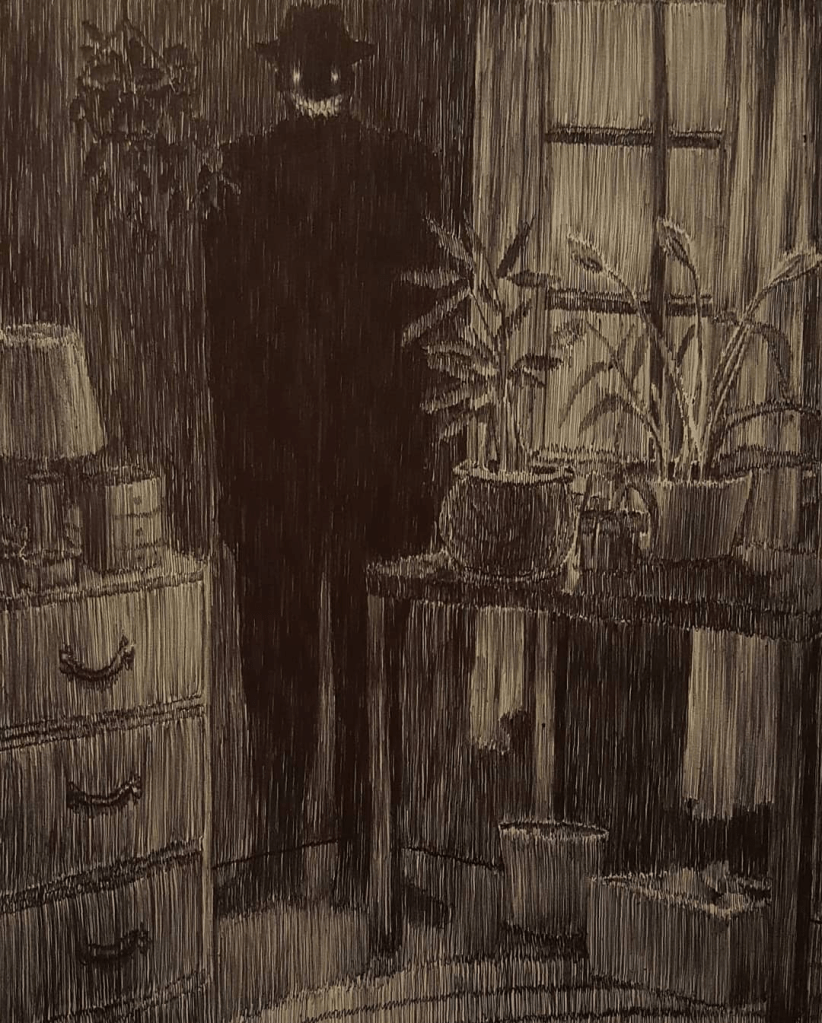
Image by Marisa Bruno

When my son was young, something happened in the night that we never discuss.

I don’t know if he remembers it. Some days, I’m not even sure it really happened.

But when it’s late at night and I can’t sleep—when I open my eyes to the lukewarm pressure of the dark—I remember what happened with a cold thrill of fear, and wonder if I’ll ever sleep soundly again.


Sebastian was a nervous child. I never knew why, but I always used to worry that it was somehow my fault.

I split up with his mother when he was six. There wasn’t much anger by then. We almost laughed at the state of it. I remember that we opened a bottle of wine and stayed up late to sort it all out.

But afterwards, I kept feeling like we’d ruined his whole childhood by failing to make the marriage work. Every time something went wrong in his life, I pictured the divorce as a dark figure standing over him. Like the opposite of a guardian angel, rubbing its hands with glee.

Maybe I’m being too hard on myself. That’s just my personality. My least favourite song is the one that goes non, je ne regrette rien, because the truth is I regret almost everything.


When Sebastian was ten, I still had to tuck him in at night. He had a superstitious terror of his own wardrobe and wouldn’t sleep unless I checked inside it for monsters. Even then, he had a lamp by his bed, and it had to stay on through the night.

To be fair, it was a scary wardrobe. A big solid unit, with a crest along the top that seemed to scowl at you.

It had once belonged to my mother-in-law. After she died, my ex thought that Sebastian would like it. He didn’t. I got him the Narnia books, hoping that he’d warm to it. He just got scared of witches.

By this point, I was starting to worry that he wasn’t as brave as the other boys in his school year. And to be honest, that bothered me. But I could sympathise, too. If there’s one thing that gives me goosebumps, it’s the thought of the supernatural. Even as an adult, I’ve been known to hurry out of a dark room, if I go in there alone and suddenly get the willies.

The funny thing is, apart from that, I like to think I’m quite brave. For instance: after the divorce, I took up free climbing. Every bank holiday, I drove to Land’s End or Malham Cove, just to see how high I could get without any gear. I was quite happy with my fingers and toes on the rockface, and nothing but fresh air under my feet.

Before Sebastian was born, I even passed selection for 4 Para, which is the reserve unit of the airborne infantry. I don’t want to overegg it because I didn’t deploy, so I’ll never know if I had it in me to be a soldier, but signing up for the reserves, and jumping out of planes, aren’t the actions of a nervous man.

Even so: if I’m alone at night and there’s a crack in the curtains, and I rise from my chair to draw them, I don’t like looking at the dark beyond, for fear of what I’ll see.


As part of my army training, I did a two week course in Catterick Garrison, which is an army town in Yorkshire. I bedded down with the other trainees in Helles Barracks. We were quite a diverse bunch. There was a mechanic from Glasgow, whose name I forget; a mature student called Ben, who sat there reading The Art of War and droning on about Tai Chi; and a placid Welshman who never said much. When he did speak, he just seemed faintly bemused. Like he’d wandered in by mistake, and didn’t understand why people were shouting orders at him, or making him run around in fields.

Then there was Jim. Jim was older than the rest of us. I forget the maximum age for reserves, but I know he was very close to it. Despite his advanced years, he was clearly the fittest of the group. He had staring blue eyes, visible veins on his temples, and not a pound of fat on his body. He was obsessed with getting his resting heart rate as low as possible, and he had this off-putting habit of feeling his throat to check his pulse. I remember Ben saying that he wouldn’t be happy with his resting heart rate until he was clinically dead.

He came from a place that he called “Kersal”. At the time, I’d never heard of it. He made it sound like the Transylvania of the northwest. A spooky little corner of Greater Manchester, where gothic scenes played out in council flats, or on the banks of the River Irwell.

“I bet it was great in summer,” said Ben—meaning the river.

Jim smiled.

“Me mum wouldn’t let us anywhere near it,” he said. “We weren’t even allowed to go past the soapworks. She reckoned that river was haunted.”

“By what?”

“She called ’em ‘geggers’.”

“Ghosts?”

Jim shook his head.

“More like fairies. If one took a shine to you, it followed you home and gobbled you up in bed. Then it took your place. No one would know it wasn’t you.”

“Why did they do that?”

Jim felt his neck, counting the heartbeats.

“God knows,” he said. “Ask me mum.”

I shuddered in my bunk. Obviously, I didn’t believe in “geggers”—or rather, my brain didn’t believe in them—but it’s funny what you feel in your bones to be true, when it’s late at night and the goosebumps come. And the goosebumps were right, as I’ll soon explain.


I met my ex in Liverpool, at a pub called The Hole in the Wall. It’s tucked away in a long narrow street called Hackins Hey, and it’s meant to be the oldest pub in the city. It’s out of the way, but I’d heard it was there and made a special trip to see it, when I was on a job in St Helens.

The Hole in the Wall was built in the 1720s. I’m no expert but it seemed a lot older. Almost Tudor, in fact. The timbers were painted black. The first floor windows had cast iron lattices. It was grubby and charming at the same time.

Inside were dark wooden panels, gleaming brass fittings and a burning fire. There were room dividers with stained glass windows. Back then, you could still smoke in bars, so the air was thick with blue-grey fumes.

Louise was standing by the bar, rummaging in her handbag. She had gleaming red hair and matching lips. I was army-fit in those days and cocky with it, so I marched right up to the bar and paid for her drink, without even asking if she wanted me to.

“Thanks,” she said warily. “Who are you?”

“Paul. You?”

“Louise.”

I asked if she was from Manchester. She had that peculiar accent, like she was talking through her nostrils.

“Not quite,” she said with a smile. “Salford.”

“Anywhere near Old Trafford?”

She shook her head.

North Salford,” she clarified. “Place called Kersal.”

I was surprised. I hadn’t quite realised that Kersal was part of Salford.

“I heard there’s a haunted river there,” I said. “Is that true?”

She gave me a withering look.

“It’s not true true, is it? Nowhere’s haunted. Not really. But we used to tell stories. There was a witch there called Wet Ethel.”

I laughed at at the image.

“Wet Ethel!” I said. “And what about—geggers?”

She looked at me blankly.

“Geggers?”

I shrugged and finished my lager. I was starting to wonder if Jim had been pulling our legs.

“Just something I heard about. It doesn’t matter.”

I offered to buy her another drink, but she insisted on getting the next round. It turned out she worked there and had only just finished her shift. We were still propping up the bar when her colleague rang last orders.

Two years later, she was pregnant and we were engaged.

We moved to Kersal to be close to her parents. I bought a house on Castlewood Road, just round the corner from the soap factory. It was the same one which, decades earlier, had marked the end of Jim’s permitted route, as decreed by his superstitious mum.

Beyond that was Agecroft Bridge, which carried cars across the Irwell.

Fate had led us to the haunted river.


When Sebastian was ten, I took him for a walk in Drinkwater Park.

We were following the river. The water’s meant to be filthy, but it’s a nice enough walk on a sunny day—and it was a sunny day. The air was almost swampy. A faint rotten smell kept wafting from the river. The sky looked raw, like a peeled blister.

I paused when I saw a giant drainpipe. It was sticking out from the far side of the river, spewing water from god-knows-where. It made a thunderous sound as it struck the surface, turning the river to white rapids.

“Look at that pipe!” I told Sebastian. “Look at all that water! Where do you think it comes from?”

He glanced across the river and his eyes widened.

“There’s someone in it,” he said in surprise.

“In the pipe?”

“Yeah.”

I turned to look again. All I could see was water coming out of it.

“Don’t be daft,” I said gently. “It’s empty. See?”

He was becoming visibly agitated, so I stopped trying to pique his interest. When we resumed our walk, he kept looking nervously around him. Then he slowed to a halt and just stood there, staring into the distance.

I started to lose patience.

“What?” I said brusquely.

He pointed down the river.

“There’s someone under that bridge,” he said fearfully.

“Where?”

“You just missed him. He’s hiding.”

I wasn’t convinced that Sebastian had seen anyone, but nor was I sure that he hadn’t. Older children often loitered in the area. Also, we weren’t far from Forest Bank Prison, which was right on the banks of the river. In the worst case scenario, it could have been a fugitive, trying to evade detection.

“What was he doing, when you saw him?”

“He wasn’t doing anything.”

“Ignore him, then. Come on.”

We walked past the bridge in silence. Once it was behind us, I risked a backwards glance over my shoulder. I couldn’t see anyone under it, but I’m not sure I would have done, from that angle.

The river shone like liquid fire, dazzling my eyes. And then—wait!—was that a dark figure—hunched over in the glare, like a goblin?

As soon as I saw it, it was gone. Was the light playing tricks on my eyes? I doubt I’ll ever know.


Some nights later, Sebastian woke me twice because of tapping on the bedroom window, which scared him.

It was a windy night and we had a tree in the garden. A large apple tree, which gave a yearly harvest of small inedible fruit. The branches must have been knocking the glass. The next day, I got a lopper from the shed and leaned right out of his bedroom window, cutting the branches down to size.

When bedtime came, I sent him to brush his teeth and promised to meet him upstairs, so I could check for monsters and tuck him in as always. Before I did, the phone rang. It was his mum, having some kind of drama with the bank. After a while of trying to help her untangle it, I promised to ring her back and got off the line.

When I went upstairs, the whole house was quiet. I wondered if he was already sleeping. I opened the door very slowly, just in case he was.

He wasn’t. His little white eyes shone in the dark. For some reason, his bedside lamp was off.

“Sorry,” I said softly. “That was your mum. You know what she’s like.”

When he didn’t respond, I went to his bedside and stroked his hair. It was fine and red, like his mother’s. I could feel heat and sweat coming off it, and wondered if he was coming down with something.

“I thought you might be sleeping,” I said. “No luck?”

He shook his head.

“Do you want me to check the wardrobe?”

He shook it again, which surprised me.

“No?”

He had the duvet pulled up to his nose. I looked at the wardrobe. In the dark, it was barely visible.

“What about the lamp?” I said. “Do you want me to turn it on?”

He didn’t answer, so I reached across the bed and pressed the button. With a sharp click, the wardrobe appeared in a pool of light.

The doors were ajar, which was strange. A vertical band of darkness ran between them, about as wide as my thumb is long.

In that narrow strip of gloom, I thought I saw a flicker of movement. One of the doors wobbled on its hinges.

A soft noise came from within, like a little gasp of air.

My mind raced but resisted horror. Surely, I thought—surely we’d let an animal into the house?

Then I remembered the bedroom window. I’d left it open when I’d finished lopping branches off the tree. Even now, the cheap curtains billowed by the bed, filling with air and slowly exhaling it. Synthetic fibres glowed in the lamplight.

It’s just an animal, I told myself. Probably a cat. That’s all.

“Stay there,” I told Sebastian.

I went to the wardrobe and opened the doors, bracing myself for a startled cat to shoot out of it.

It wasn’t a cat.

Hugging his knees on the sock drawers—cowering among his own school shirts—was Sebastian, my son.

He looked up at me in terror. My mind reeled as I heard his words:

I don’t know who that is in my bed.”

As if in a dream, I turned to see.

The thing in the bed that looked like my son was sitting up now—grinning right at me.

It wasn’t a perfect copy. The smile was too wide. Cheeks stuck out to make room for it. Five inches of grinning teeth, gleaming in the lamplight.

“Ge-e-e-egh!” it croaked—clacking its horrible jaws at me.

The room span, and I’m not ashamed to say I fainted.


Some time later I woke with a start.

It was dawn by then. The birds seemed aggressively loud. Through the wide-open window, liquid light came flooding in.

Sebastian was curled up behind me, still in the wardrobe. He was snoring softly with his hands on his face. I moved them gently to check his features. They were perfectly normal.

“Sebastian?”

He whimpered softly but didn’t wake. I picked him up and managed to carry him to my room. He woke briefly on the landing and stiffened with fear, so I held him tight and shushed him.

“You had a nightmare,” I lied.

When we rose at noon, he showed no signs of remembering—but nor did he ask why he’d slept in my bed—so I guessed that he remembered something. Maybe just being carried. A vague recollection of a night terror.

I knew that I’d come face-to-face with a “gegger” that night, so Jim’s words came back to haunt me: “If one took a shine to you, it followed you home and gobbled you up in bed. Then it took your place...

I kept glancing at Sebastian, looking for clues that something was amiss. Was it my real son? Or a changeling? In the days that followed, I asked him questions, checking for things that no one else would’ve known. I came to the conclusion that, if it wasn’t him, it was doing a damn good impression.

But that left a lingering mystery: why didn’t the gegger take him when it had chance?

The terrible thing is, I’ll never know what happened when I was out cold. All I can say for sure is, when I fainted, I collapsed right in front of my son. Maybe that was enough to discourage the gegger? It would have needed to climb over me to get at Sebastian. Was that enough of a deterrent?

I guess so. And yet…

Here’s what bothers me, even now. After the events of that terrible night, my son no longer needed me to tuck him in, or check inside the wardrobe for monsters. In that regard at least, he was a changed boy.

I like to think that, somewhere in his brain, his subconscious knows what happened that night, and the experience toughened him up. It’s a nice idea, because the alternative is unthinkable.

I have a recurring dream, or rather nightmare, and hope to God it won’t come true. I dream that I’m an old man, lying at last on my deathbed. Sebastian sits beside me. I can hear the peep—peep—peep of my heartbeat slowing down on the monitor.

When the time comes for me to die, he takes my hand and leans across the bed. I look up at his face. When I do, he smiles a terrible smile that’s far too big, and I know the monster got him after all.


Ellis Reed, 08/03/2024

(Author’s note: this story took some inspiration from a two sentence horror story by Juan J Ruiz.)
The House on Blackfield Lane

Based on the above illustration by Marisa Bruno

This is another passage from the spirit-writing of local psychic Keith Credge (1943-2004).

In the last years of his life, Mr Credge claimed he was taking dictation from lost souls during hundreds of trance sittings. Most of the writings are fragments but others take the form of complete narratives. Rose’s story is exceptional because parts of it have been verified (as far as these things can be) by the Society.

Out of respect for the surviving relatives, her surname and house number have been removed from the transcript.

Broughton Society for Paranormal Research, 31 October 2020


I’ve been alone in the dark for five thousand and twenty-two days now with nothing to do except get my thoughts in order, so I’m happy to tell my story and think I’ll do it well.

My name is Rose. I was brought up near Moor Lane, in a Salford suburb that was almost Prestwich. I knew this from an early age because my parents were incapable of saying where we lived without quickly adding that it was almost in Prestwich. When Engels came to Salford in the Nineteenth Century, he found an old man living in a pile of dung, and a critic would say it hasn’t changed much—but our corner of the city was nice enough. Maybe because it was almost Prestwich.

There isn’t much to say about my youth. My early memories are a jumble of dream logic and magical thinking, stitched together like a patchwork quilt. When I got older I folded it up and put it away. It’s still there in the back of my mind and it smells faintly of the sea and sun-cream. I find it a comfort in this dark place, where I’ve been stranded for five thousand and twenty-two days, with nothing to do except get my thoughts in order.


In adult life I was the senior editor of a publishing house, with a secret ambition to write my own literary fiction. My husband was a GP in Cowley. We were very comfortable in Oxford, but I wanted to retire to Greater Manchester because all my family were there. My husband was sceptical of Salford—“almost Prestwich” or otherwise—until a beautiful house came up for sale on Blackfield Lane.

We weren’t ready to retire but I thought we could rent it out in the meantime. My husband grumbled but acquiesced. Since it was my dream rather than his, we agreed that I would take the sabbatical to do it up. Thus I found myself boarding a train to Manchester on a cold wet day in November, full of ideas about real fires and oval rugs and crystal chandeliers.

It was raining when the taxi brought me to Blackfield Lane and it’s raining now. I can’t see it but I can hear it. The wind-whipped droplets, lashing the house like handfuls of rice.

I’m still here, you see. I vanished but I never left.


When I first arrived, it was already dark and raining hard. Great liquid sheets of it, hitting the ground like glass meteors. I put my jacket over my head and ran to the door, cursing the strange new keys as I fumbled with the lock.

When I finally got inside, the first thing to hit me was the smell of damp. I walked through the house in a horrified daze, tormenting myself with long deep sniffs. Where was it coming from? Would it ever go? What if a time came when we thought it was gone, but we’d just got used to it, and people were too polite to say?

I made my way through the house, opening all the windows. I wanted to catch something red-handed, like a leak in the ceiling or rising damp, but there was nothing obvious. Nothing at all. The whole place simply stank.

“Great,” I said out loud.

I plugged in a phone and got a dial tone, which was a small victory. We’d asked for the line to be re-connected but didn’t think it would be. Then I rang my husband to tell him about the smell.

“What about the rest of it?” he said.

I looked around.

“Well you saw it yourself,” I reminded him. “It’s quite presentable. If we’re having tenants, we can leave most of the rooms till we move in ourselves.”

“Are we, though? I don’t think we decided.”

“I suppose we didn’t. What do you think?”

There was a long pause.

“Well we don’t need the money,” he pointed out. “Do we?

We agreed to discuss it another time, but I think we’d reached a point where neither of us could be bothered renting it out. It was a small weight off my shoulders, of the kind you don’t even notice till it’s gone.

I unrolled my inflatable mattress and bedded down in one of the rooms. It took a long time to get to sleep, and I began to wonder why I hadn’t booked a hotel for the first few nights—at least until I got a bed delivered—but I couldn’t go back in time. I just lay there feeling sorry for myself.

When I finally nodded off, I had a nightmare.

In my dreams it was raining and the rain was getting in. I watched in horror as it came through the ceiling and ran down the walls. The plaster was so damp it had all turned to mush. I scooped it off in handfuls, trying to work out how bad it was.

Deeper and deeper I went into the wall. I couldn’t even find the brickwork beneath. I can’t remember what I did find, but I know I woke up screaming.


The next morning I explored the house properly, this time in a better frame of mind.

The previous owner had started to improve the property, apparently without much conviction. Here and there was evidence of half-finished work, like a bag of screws with the corner ripped off, or a dusty hammer stood on end. A post-it note with a plasterer’s number had fallen to the floor and curled up, like something that had died of old age.

I poked my head in the loft and was surprised to find a folding camp-bed. It looked a lot better than the inflatable mattress, so I lowered it through the hatch on the belt from my dressing gown. Then I went to a charity shop in Prestwich and paid for a chest of drawers, a small table, a jewellery box and a lamp. My plan was to put them in the room with the camp bed, just to make it more cosy in there.

I can still see them now. They’re set out before me, right where I left them. When morning comes, they’ll be thick with dust, like they were yesterday, and the day before, and the day before that. I’ve watched the dust settle for five thousand and twenty-two days, like a blizzard of snow in slow motion. Tomorrow, it will be five thousand and twenty-three, and the dust will be a tiny bit thicker. This is how I live now—watching the dust as it fills the room.


By the end of the week, I wasn’t worried about the smell any more because it seemed to have gone. I was coming and going enough to think that, if it was still there, I’d at least notice when I came back from town. I put it down to the house being uninhabited for several months with no ventilation.

It was surprisingly hard to get contractors to come. A decorator poked his head in the bathroom and promised to get back to me with a quote, but I hadn’t heard back and felt I never would. I went to B&Q and had a long talk with them about a new kitchen, but they weren’t due to visit for a while.

In the meantime, my husband and I formally agreed that we wouldn’t bother looking for tenants, so I made a start on stripping the rooms and planning the décor. In the evenings, I half-heartedly worked on a novel I’d been trying to write for nearly eight years, which began with the joyless words, “The whole house smelled faintly of lamb but dinner was ruined.”

“I think I misjudged this,” I told my husband on the phone. “I thought I’d have a team of people to manage, but it’s all so slow. I need something to happen.”

I could tell he was smiling at the other end.

“Be careful what you wish for,” he reminded me.


That night I had another bad dream.

It was the same as the first one. All the plaster in the house had turned to wet mush. I clawed it off the walls in a blind panic, trying to work out how bad it was.

Before long, my fingers discovered something in the plaster. It was the brim of a hat, caked in wet cement. I wiped it clean then backed away in horror.

A living face was buried in the wall, with two bright eyes and a mouth like the moon.

It leered at me like the Cheshire Cat and I woke with a cry of fear.


When morning came, the room smelled of damp. I sat up stiffly and saw, to my horror, a huge wet patch by the window. It started at head height and went all the way to the floor.

I got up and went to investigate. It was almost the shape of a man. Halfway down the wall it split in two, making an uneven pair of legs.

“Great,” I said sarcastically.

I brushed my teeth and found a Yellow Pages. I tried eight builders and only one of them answered.

“I’ve got water coming in,” I told him.

“Down from the ceiling or up from the floor?”

“Neither.”

“Eh?”

“It’s starting half way up the wall.”

I could hear him checking a diary.

“Well I can’t get there till next Friday,” he said. “I can do—one o’ clock on Friday?”

It was far from ideal, but no one else answered so I had to take it. After I hung up I went through the whole house, obsessively sniffing and checking for leaks. I didn’t find any others but I postponed my plan to hang the new wallpaper. I felt irrationally sure that, wherever I put it, rain would come in and instantly ruin it.

The downpour continued on and off for the whole day. The damp patch didn’t grow or change shape. It just got darker.


On day ten, I woke to what I thought was an intruder in the corner of my room. When my head cleared and my heart stopped pounding, I saw that it was just the damp patch on the wall. It really was uncanny, the way it resembled a man. I could discern a head, shoulders, waist and legs, but it was just my brain looking for patterns. I struggled to remember the word for this and it suddenly came to me.

“Pareidolia,” I said in triumph.

I had no choice but to wait for the builder. In the meantime, I kept checking the damp. I’d never seen a leak at head height before. There must have been a crack in the bricks, I realised, because I could see the shape of the fissure where the water entered. It was a band of damp across the top of the head, like the brim of a hat. It gave me an eerie sense of déjà vu but I couldn’t think why.

After dinner, when I sat down to write, I put my long-suffering manuscript away and tried something new. “I had no choice but to wait for the builder,” I began. “In the meantime, I kept checking the damp.”

There was a peal of thunder and it started to rain.


The contractor postponed twice but eventually came to look at the leak.

“It’s through here,” I told him.

He stepped into the room and looked around.

“Where?”

“Right there,” I told him. “In the corner.”

Which corner, sorry?”

I looked at him in surprise. He was blinking right at it.

Then my skin began to crawl because it was clear he couldn’t see it.

That corner,” I said—pointing it out.

He went to check but seemed bemused.

“It looks fine,” he said.

I didn’t know what to say because it couldn’t have been more visible. Not to me, anyway. I was fearing for my sanity at this point but didn’t want to make a scene.

“Well it’s fine now,” I lied. “But that’s where it gets wet, when it rains.”

He pressed his hand to it, getting black he couldn’t see on the tips of his fingers.

“It feels dry enough,” he said. “So you won’t have to replaster, at least.”

“Well that’s good,” I said weakly.

He went through the motions and found a cracked slate at the edge of the extension roof. It wasn’t in the right place, but he gave me a rehearsed spiel about how water finds its own route, then offered to come back and fix it for eighty quid. After I accepted he left me in a daze.

Eventually I rang my husband.

“How did it go?”

“There was a cracked slate on the extension roof,” I heard myself say. “The water found its own route. He’s coming back to fix it.”

“I suppose you’ll need a plasterer next.”

“He didn’t think so.”

“Really? You said it was a right mess?”

I turned to look at the dark shape in the corner. It—or was it him?—seemed to be watching me.

“I must have been exaggerating,” I said.


For the next few days I seemed to move through life in a dream. I kept finding myself in the room with the damp patch, looking at it in confusion.

Before long, I no longer thought of it as a damp patch. Other people could see damp patches. It was simply the shape of a man with a hat. It reminded me of those shadows in Japan, etched onto buildings by nuclear fireballs. They were the outlines of people who had died, frozen in time in Nagasaki, or on the steps of a bank in Hiroshima. Mine was waiting by the window, loitering among the house plants.

But waiting for what?

I considered moving out, or at least picking another room to sleep in. For some reason I didn’t. A peculiar sort of fatalism had come over me. I don’t think I ever got over the shock of discovering that only I could see it. From that point on, I sleep-walked through my life, doing bits of DIY in the day and staring at the shadow in the night. Before long, it even had a face. Two bright eyes and a mouth like the moon, watching me from the corner of the room.

You’ve guessed by now that my story doesn’t have a happy ending. Whoever he was—whatever he was—a time came when he stepped off the wall and came to life. I woke in the middle of the night to find him standing at the foot of my camp-bed, grinning down at me.

When I tried to scream, he climbed on the mattress and pressed a cold hand over my mouth. The smell of mildew was so strong that I almost passed out.

Very dimly, I remember him lifting me from the bed and carrying me to the corner of the room. Then—somehow—he sealed me in the wall he’d come from. It gave way like porridge and swallowed me whole. He stood back to admire his handiwork then melted into nothing.

And here I remain. I can still see the room but I no longer have my former shape. I’m two-dimensional now, spread through the plaster like a web of spores—or maybe just a patch of damp.

From my strange new vantage point, I watched my husband, and then my sister, and then the police come to visit. I was powerless to call out to them. I saw them slowly give up on me. I watched in silence as dust filled the room and settled on my possessions.

I don’t know who the man was, or why he put me here, or where he went, but I strongly believe that my capture was the price of his freedom. It has a perverse sort of logic. One in, one out. The house must have its ghost. If you sleep here you will dream of me, just as I dreamed of him.

I’m waiting for the day when someone else buys the property and moves in. I’ll see if I can will myself into existence, like he did, until I’m strong enough to step off the wall and seize my replacement. Then I’ll melt into darkness and simply go away. To heaven or hell, if those places are real, or the never-ending peace of non-existence, I cannot say.

In the meantime, I’ve been alone in the dark for five thousand and twenty-two days with nothing to do except get my thoughts in order. Tomorrow it will be be five thousand and twenty-three and the dust will be a tiny bit thicker. This is how I live now—watching the dust as it fills the room.


The narrative you just read was produced by Keith Credge over the course of four different sittings. After his death, it was edited into a single document by volunteers at the Broughton Society for Paranormal Research. Edits were made to correct misspellings, redact personal details and remove duplicated material. Other than that, the original text was unchanged.

In recent years, we’ve established that a woman called Rose did indeed move from Oxford to Kersal and subsequently vanish. The house on Blackfield Lane remains in her family and is presently unoccupied—or, at the very least, has no living tenants.

Broughton Society for Paranormal Research, 31 October 2020


Ellis Reed, 01/11/2020