I grew up in Broughton, near the cottages and long cobbled streets of the cliff.
The cliff was a conservation area, which meant that Salford City Council watched it like a hawk. Here and there, you would find sage-green Victorian lamp-posts, or the ghosts of old tramlines cutting through the road. Relics such as these were sacred to the council, who did everything in their power to preserve them. There was also an actual cliff there—hence the name—but it wasn’t much of one. Just a steep sandy drop, carved out by the bend of the river. Every now and then, another bit of street went sliding down the slope, and more of the old tramline was lost forever. As a result, and despite the best efforts of the council, the whole neighbourhood was essentially doomed.
We often walked that way, Ruth and I. We would stroll through it till we reached the bollards at the end of Cliff Crescent. Then we would go our separate ways. Mine up Bury New Road, hers across Northumberland Street.
There was nothing for us to do round there, but I suppose we liked the atmosphere of the place. The cliff itself had a strange quality that our young minds couldn’t quite process, and the impression it made was all the more profound for being inexpressible. When we peered across the concrete barrier, we saw how the ground simply fell away, and it made us feel as if the whole of the human world, which normally seemed so solid and durable, was actually fleeting and ephemeral. I think we just liked to be there, so we could soak up the feeling of impermanence.
I remember the two of us walking down it one evening in June. I was thirteen that summer and so was she. As dusk began to fall, we found a house that we’d never seen before, and I remember how we slowed to a halt and just stood there for a while, admiring the front of it. The whole house was filled with amber light. There was so much light it overflowed the windowsills, making the drive the colour of Lucozade.
“It’s like a magic cottage,” I said in awe.
We basked in the orange light, wondering how it was possible that we’d never seen this beautiful house before. Then Ruth solved the mystery.
“We have seen it before,” she realised. “Lots of times. It was a complete wreck, wasn’t it? They’ve done it up.”
As soon as she said it, I knew that she was right. The last time we’d walked along the cliff, the house had been little more than a shell, with wild brambles flooding the porch. All but one of the windows had been boarded up. Since then, someone had completely renovated it, and I was surprised that they’d done the work so quickly.
“You’re right,” I said. And then, more shyly: “Do you think we’ll have a house like that?”
She smiled at me.
“May-be,” she said teasingly—“if one of us wins the lottery!”
Before I could protest—because I planned to get rich on my own merit—the front door clicked open, and we watched in surprise as it swung soundlessly ajar.
Orange light poured from the crack. It seemed to waver slightly, as if something was stirring in the bright hallway—just out of sight—casting long ripples of shadow.
“Come inside,” called a woman’s voice from the hall.
Ruth instinctively moved to obey, but I restrained her arm.
“Don’t,” I said quietly. “We don’t know who it is.”
She looked at me in surprise.
“What do you mean? It’s person who lives there.”
“It’s just—creepy.”
“Come inside,” called the voice again.
I ignored it and tried to lead Ruth away, but she shook me off in irritation.
“It’s just the new owner,” she said. “She probably wants to show her house off to someone.”
“Come inside,” called the voice a third time.
The repetition didn’t sit well with me. The woman in the house hadn’t added anything, or explained anything. She’d just said it again. And there was something uncanny about it. The repetition, I mean—like the not-quite-human voice of a parrot.
“Ruth?” I said nervously.
The orange light was getting brighter and brighter. She almost seemed hypnotised by it.
“I’m going inside,” she said at last. “You don’t have to come with.”
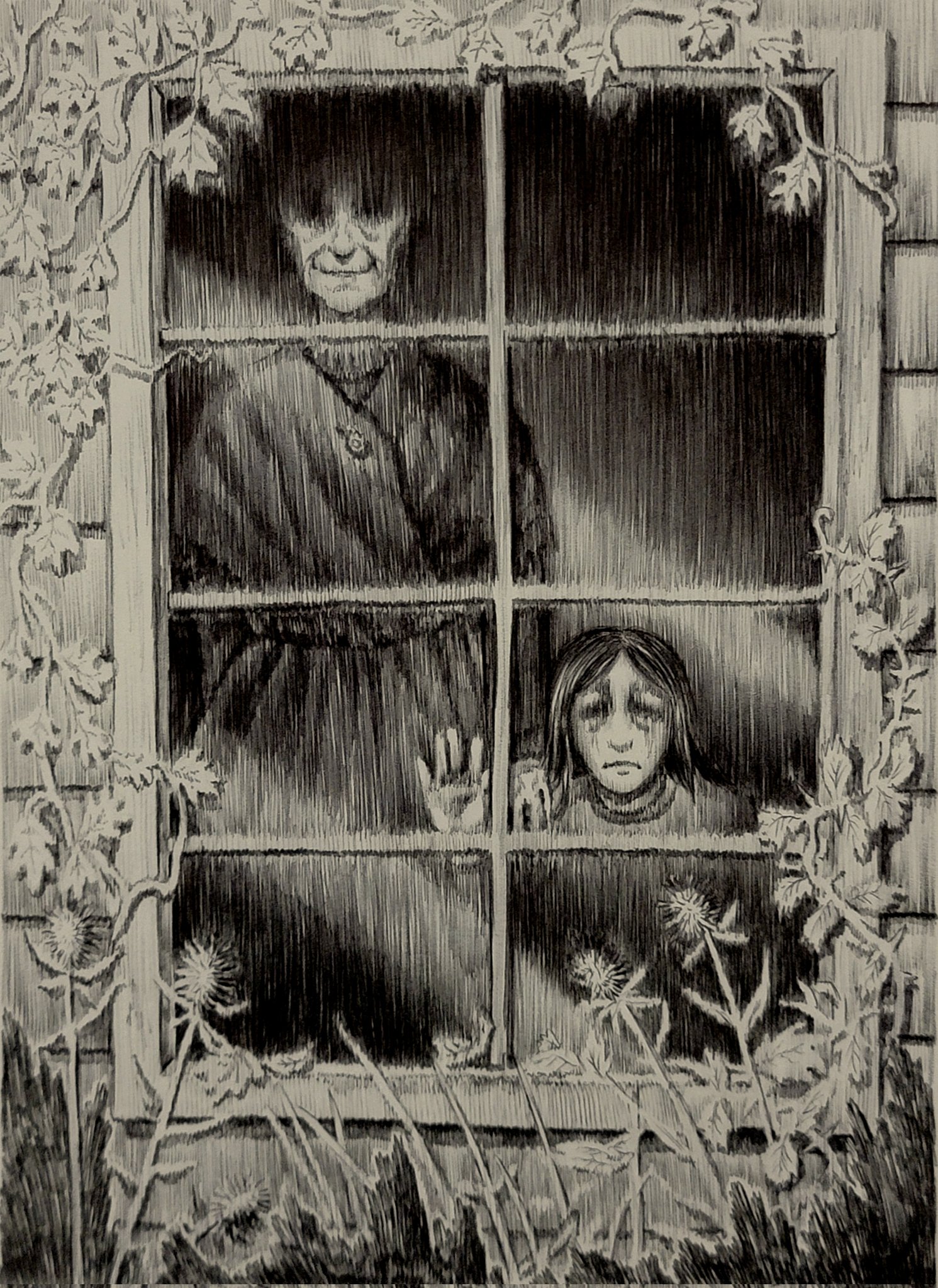
As she marched up the drive, I glanced at the first floor windows. One of them wasn’t lit like the others. In the gloom beyond the glass, I could see the ghostly outline of an old woman looking down at us.
“Ruth,” I said more urgently.
The top of the woman’s head was wholly lost in shadow, but I could just about see the bottom of her face. The white contour of her chin, and the small triumphant curve of her mouth.
“Ruth!” I started to beg—but it was too late. I watched her enter the doorway, and saw how she seemed to dissolve in the orange light. I remember that very clearly: sheseemed to dissolve in the orange light. The door shut at once behind her, and I thought I heard a faint malicious laugh from above.
“Ruth?” I called a final time—but the spell was broken. I rubbed my eyes in confusion. It felt like I was waking from a dream. There was no orange light, I realised; just the faint blue gleam of nightfall.
When I looked at the house with fresh eyes, I saw that it hadn’t been restored at all. Brambles flooded the porch, just like before. All but one of the windows were boarded up. The one that wasn’t boarded up, I now realised, was the one on the first floor, where I thought I’d seen the old woman. But was that just a dream?
“Leave now,” the wind seemed to sigh. “Leave forever.”
The whole thing had been an illusion, but Ruth was still gone.
I fled the scene in confusion. And poor Ruth, she was never seen again. Except maybe once—but I’ll come to that in due course.
The adults knew that Ruth and I were sweethearts. As a consequence, when she never came home, they wanted to speak to me. First my parents—then her parents—then the police.
I simply feigned ignorance. It was easy to pretend that we’d gone our separate ways at the bollards, like always.
For a short time, they actually had a suspect, because there was someone nearby with the right kind of criminal record. Nothing came of it, of course, because he had nothing to do with it. They released him without charge, and after that there were no more developments.
As far as I know, Ruth’s disappearance is now classified as a “cold case”.
I went back there once, years later. I was dismayed to find that the derelict house was still standing. As before, all the windows were boarded up, except for one on the first floor. When I looked up at it, there was a moment—a fleeting moment—when I thought I saw Ruth looking out from the glass. Help me, her eyes seemed to say.
She wasn’t alone. An old woman’s hand lay protectively on her shoulder. The top of her head was lost in gloom, but I could still see the bottom of her face, with that same triumphant smile.
I don’t visit the area any more.
Sometimes, I’m troubled by the thought that Ruth will be trapped in that house forever, shut away with the ghostly woman who lured her inside.
But then I remember how the river still sweeps across the land, carving out a valley, eating at the edges of suburbia. I remember the cliff, and console myself with the thought that the whole conservation area is doomed to go tumbling down it.
When that happens, nothing will remain of the derelict house.
I don’t know where Grandma came from, but it must’ve been somewhere, and wherever it was, it surely wasn’t here.
She had the faintest trace of an accent, which seemed to recall the gloomy pines of the Black Forest, or maybe the foothills of the Carpathians. Her mottled arms were always brown, like she’d caught the sun in a faraway land and never let it go.
She knew the ways of the woods and wild places, but if you asked where they were, she’d only smile and shrug. Not in the innocent way that meant she didn’t know, but the impish way that meant she wouldn’t tell you.
Her teeth were long and yellow, and I once saw her pluck a spider from its web and eat it whole when she thought I wasn’t looking. It was the only thing I ever saw her eat that wasn’t a beef paste sandwich or tinned fruit. She drank steaming brews that she called “tea”, but they didn’t smell like normal tea. I felt then, and feel now, that she was a witch.
We saw a lot of her because she lived at the far end of our street, which was a place called Nevile Road. From an early age, my sister and I were allowed to walk between the two homes, past the football ground and little school, and the tiny power station (or whatever it was) with the sign that said it would electrocute you. From Monday to Thursday, Mum would still be working when school finished, so we had to wait at Grandma’s for a phonecall.
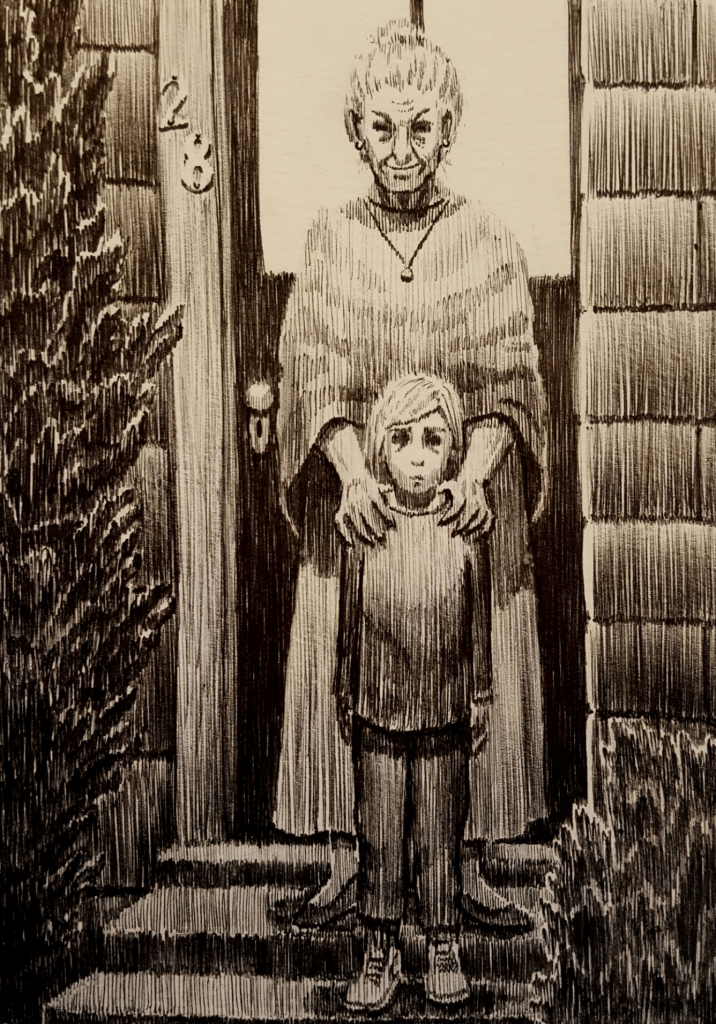
From the outside, Grandma’s house was no different to the neighbours. It had PVC windows and render on the first floor. Inside, it smelled of incense and raw meat, and something else you couldn’t name. On the smoke-stained walls were pictures of strange gods, like the masked woman with the moon on her head, or the one with horns who sat like Buddha. When I asked Grandma who they were, she just smiled and shrugged.
She had a lot more patience with my sister. Maybe because she wasn’t a boy.
“Do you believe that people have souls?” my sister asked her, when she was making a beef paste sandwich.
“I do,” she replied—slopping it on the bread. It smelled like dog food and sparkled wetly.
“Where do they go when we die?”
“Nowhere,” said Grandma. “If your soul is in your body when it dies, it simply dies as well.”
I looked up from my comic.
“What’s the point of a soul,” I wondered, “if it dies when you do?”
She just smiled and shrugged and ate her sandwich.
I’d say that Grandma took a special interest in Sarah, which was fine by me, because their conversations sounded like hard work. Once, when I went upstairs to use the toilet, I heard them talking in one of the rooms. It had been a bedroom once and now was full of knick-knacks.
“Liberate your mind,” Grandma was saying. “Separate the spirit from the flesh.”
“I don’t know what you mean,” my sister groaned.
“Of course you do,” Grandma snapped. “But you’re breathing wrong. Use your mind instead of your lungs. Breathe the light and not the air.”
It looks very mysterious when I put it down on paper, but at the time, it just sounded boring. Grandma had the weary tone of a Latin master, ordering a child to conjugate a verb for the hundred thousandth time. I’d heard stuff like this before, but gave up asking what it meant, because my sister got embarrassed, and Grandma just smiled and shrugged. Better Sarah than me, I thought. I continued to the toilet, then back downstairs to read my comic.
Grandma’s death, when it came, was surprising but swift. I believe she got a rare kind of dementia that happened overnight, which must’ve been vascular, or maybe the result of a stroke (if that’s not the same thing). We never saw her like that because Mum thought it would upset us. “It’s like she’s a child again,” she said tactfully. When I begged for the detail, she added: “Well basically, she’s forgotten who she is. She thinks I’m her mum, and she’s always scared, and it’s not nice to see.” When she took over Grandma’s affairs, it turned out she’d been living with terminal cancer, which was almost a mercy, given the state of her mind.
We never saw her again. I believe she was looked after in a special kind of hospice till she died two months later, the day before Christmas Eve.
The last time I saw her was the day before she lost her marbles and got taken away. It was a crisp October evening, midnight-dark at eight p.m. The autumn air was like cold hands pressing my face. We’d been waiting with Grandma after school as always, and Mum had just phoned, so we were leaving the house to walk back home.
“Sarah?”
It was Grandma’s voice. We turned to see her standing in the door. The hall behind her was a strange haze of orange light and incense smoke.
“I’m ready,” she said. “It has to be now.”
I looked at my sister in confusion.
“What does she mean?”
“I don’t know,” Sarah admitted. “It’s like—a weird prayer I had to learn.”
“What kind of prayer?”
“Oh, some stupid thing. You know what she’s like. It won’t take long.”
She went to join Grandma inside. I took a couple of steps to follow, but before I could, a long brown arm snaked out of the light, slamming the door in my face. I waited by the gate with with my school bag, hoping it wouldn’t take long.
I don’t know how much time went by, but I know I heard a faint cry inside. Suddenly, the wind seemed to quicken around me, and the dark was somehow darker. I was gripped by an irrational fear, like cold water filling me up. It reminded me of the moment in a bad dream, when you know, without knowing how, that something awful is going to happen.
The feeling vanished. The door opened and my sister came out, walking with a strange new posture.
“What happened?”
“Nothing,” she said. “Come on.”
I looked at the house and saw, to my surprise, that Grandma had come to one of the windows. She pressed her hands to the glass and looked out in fright, like she couldn’t believe what had happened.
“Is she okay?”
“She’s fine.”
I hurried to follow my sister down the road.
“What did you do in there?”
She just smiled and shrugged.
Grandma’s house was left to Mum, who left it in turn to Sarah and me.
By then, we were all grown up. Sarah bought my half and kept the house to live in. She remains at the end of Nevile Road, and survives, as far as I can tell, on beef paste sandwiches and tinned fruit. She knows the ways of the woods and wild places.
I sometimes remember what Mum said about Grandma’s “dementia”, but I try not to, because the implications are too awful to contemplate.
“She thinks I’m her mum, and she’s always scared…”
Sarah and I aren’t close nowadays, but I see her from time to time. When I point out the uncanny resemblance between her and Grandma, it always makes her chuckle. People even say she has Grandma’s laugh, which is strange, because it’s true. And I swear she never used to.
It’s strange how long that summer seemed. We were fourteen that year. The days buzzed around us like a swarm of midges. The long holiday stretched out before us, as bright and as wide as the River Nile.
There was a gang of us who knocked around together. We weren’t popular at school, but—with the possible exception of Tim—were far from the bottom of that brutal pecking order (Tim had the distinction of being very large but very soft, with a lisping voice that hadn’t really broken). Aside from Tim, there was Jon Jones, who was pretty tough; “Mandy”, or Tom Manders; and finally me. We’d bonded over a love of electric guitars, 80s horror movies, and video games like Mortal Kombat.
One day in August, there was a heatwave, so we decided to camp near the river in the park. I don’t remember who said it first. I don’t even think it was our idea. It was simply there, humming in the hot air, till someone gave it voice.
I remember I’d been lying in bed some nights before. The window was open. The air was warm and almost still. Out in the dark, something made a soft knocking sound, like coconuts or bits of wood. I couldn’t tell if it was a nearby tapping or a distant pounding, but whatever it was seemed to call me from my bed, urging me to rise and rejoice.
I was in the fairyland at the edge of sleep. As my thoughts turned to mush, I pictured a girl running through the dark valley, banging two sticks. Come and play, she seemed to call. Come and play. The river ran beside her like a friend. Then I was asleep.
The next day, we gathered at the top of Moor Lane and hurtled down it on our bikes. Halfway to Kersal Vale, one of us cried, “Let’s go camping!” Maybe it was me.
None of us had tents but it didn’t seem to matter. We’d been sleeping with our windows open and the covers off, so were just as happy to kip in our clothes on a bit of soft grass. The plan was, Tim and I would tell our parents that Mandy was having a sleepover. His mum was dead and his dad was in prison, so he lived with an adult brother in Kersal Vale. “Big Mandy” was far from neglectful, but he was a brother rather than a dad, and more than happy to cover for us.
Jon didn’t need to make arrangements. His parents were spending the night in Burnley because his grandma was starting to struggle. They’d been doing it more and more since she’d had her mini stroke. When school started, Jon wasn’t coming back, because they were getting a place in Accrington. On the last day of term, he even got us to sign his shirt, like the fifth-years do when they’re leaving forever.
Just as the sun was setting, we gathered at the bottom of Rainsough Brow, on the corner of the junction with the mini roundabout. There were no mobile phones then, so we’d planned the rendezvous on our landlines—which, looking back, seems as quaint as using walky-talkies, or whispering into tin cans. These were the days when you knew your friends’ numbers off by heart, because that was the only way to talk after school—short of going round in person—and you had to dial the numbers by hand.
“Right,” said Jon. “Did you all bring torches?”
We had. Poor Tim’s was more of a toy than a proper torch, so we spent a good few minutes taking the piss out of him.
“And what about food?”
We opened our rucksacks for inspection. I’d made tuna paste sandwiches and wrapped them badly in clingfilm. I’d also nicked some Mars Bars from the cupboard and filled a bottle with Ribena. Tim had brought literally nothing but a twin-pack of Bourbon biscuits, which cost about 20p from Tesco, so we jeered at him again. Mandy had three different types of cake bar, and—this also got some jeers—a single bag of prawn cocktail crisps, which had popped in transit.
“Good,” said Jon.
Then he smiled and unzipped his bag. Instead of food he had three big bottles of cider. He also had two packets of cigarettes, though one was open and looked a bit crushed.
Mandy whistled appreciatively. Tim looked around nervously, as if we might get arrested. Then we zipped our bags up and made our way to the nearby park.
The park follows the river, all the way to Whitefield at least. It’s funny how much green there is, so close to the greys of suburbia. You can walk all the way from Rainsough to the big Tesco in Prestwich, and it’s river almost all the way. Within minutes of leaving the mini roundabout, it was like we were in the middle of nowhere.
“Funny how close we are to the country,” said Tim.
Jon snorted.
“It’s not the country, you pillock. It’s Drinkwater Park.”
“I know. But it’s like we’re miles from anywhere.”
“Yeah. Thank F░░░ for all them Bourbon biscuits, eh?”
We laughed but knew exactly what Tim meant. We were following the river north and could have been anywhere on Earth. Water shone to the left of us, mixing colours from the sky with the faint green tinge of chlorophyll. The river made a soft liquid sound, lapping the grass that grew on its banks. Birds twittered in the dying light.
Before long we had to use our torches. We swung them in the dark, watching shadows lean in and then draw back. Our conversation dwindled, till all we could hear was the plop-plop-plopping of the river.
Then, once more, there came that strange knocking sound. It could have been soft and near or loud and far, but it made me shiver—in a nice way, I mean—like the thought of a coming birthday.
“What’s that sound?” I wondered.
They all knew what I meant.
“Dunno,” said Mandy. “But I like it.”
It was a strange thing to say, but I knew what he meant as well.
Later in life, it became important for me to work out exactly where we were that night. I know we hadn’t got far because we kept mucking around. At one point, we were chasing Tim, flashing torches in his eyes and trying to make him have a seizure. We stopped for sandwiches and some of the cake bars. I know we’d gone past the prison, because Jon made fun of Mandy’s dad—and I know there was a bridge, because Mandy did a piss off the side of it. We were a short way past the bridge, and that’s all I know for sure.
“It’s spooky at night,” said Mandy.
To lighten the mood, he shone his torch up his chin and did a manic laugh.
“Does anyone know any ghost stories?”
“Nah,” said Tim.
He was trying to sound blasé but I knew he was nervous. He was visibly relieved when Jon—the de facto leader of the gang—scoffed at the suggestion.
“It’s not a bloody cub camp,” he said. “Let’s have some cider and smoke these fags.”
He balanced his torch and got the bottles out. We passed them around, wincing at the sharp taste. Then he tried to light a cigarette, holding it over the lighter like a candle.
“You’ve got to put it in your mouth,” said Mandy.
Jon scowled.
“Does it matter?”
“Yeah. You’ve got to suck it. If you do it like that, you’re just toasting it.”
Jon tried it Mandy’s way. When it worked, he coughed out a cloud of smoke.
“Oh yeah,” he muttered.
He tried a second time and managed to get it down. It came out in a long shuddering breath, like he was on the verge of coughing again.
“Tastes pretty good,” he said, trying to save face—but it was a ridiculous thing to say—because it was a Lambert & Butler, rather than a Romeo y Julieta.
We all smoked except for Tim, who reminded us piously that “Gramps” had died of lung cancer. Jon pointed out—not unfairly—that “Gramps” had been eighty years old, and twenty stone if he weighed a ounce. All things considered, Gramps had had a pretty good innings.
Eventually, feeling a bit sick, we finished the cigarettes. Mandy checked his watch.
“It’s still early,” he said. “Should we carry on walking?”
“Nah,” said Jon. “We’ll end up at Tesco’s if we’re not careful.”
He turned his back to the river and shone his torch through the trees. We could hear the knocking again. It seemed to come from the other side.
“Let’s explore,” he decided.
We made our way through the dark trunks, snagging our jeans on brambles. Soon we were lost in a wild wood, glimpsing stars through the broken canopy.
“We’re nearly through,” said Tim.
Ahead of us was a dark building, blotting out the sky. Even in the moonlight, you couldn’t see much except for the size. We emerged from the trees and hurried over, shining our torches this way and that.
“Where are we?” I wondered.
Mandy shrugged.
“Dunno. Looks empty.”
It was a Georgian manor with tall sash windows. In the dark, they were bars of chocolate stood on end. Some of the panes were smashed. The house was made of brick but had a stone porch, with two pillars and a pediment.
I shone my torch around. Whatever it was, it didn’t seem real. Torches have a funny way of destabilising things. I think it’s the moving shadows. Ripples of chiaroscuro, spreading like a strange liquid.
“The door’s open,” I realised—shining my torch.
“We’re going in,” said Jon.
Tim looked at him in horror.
“Don’t be daft,” he begged. “It’s trespass!”
Mandy and I looked at each other. We had to pick a side. We didn’t want to go in the old house, but the alternative was joining a tragic faction led by Tim.
“We could call through the door,” said Mandy. “If no one answers—it’s probably safe to look around?”
I shrugged. It seemed like a fair compromise.
“Okay,” I agreed. “Do it.”
Jon marched up to the open door.
“Hello?” he called. “Hell-o?”
No one stirred inside, so he took a deep breath.
“Scrubby-dubby-doo-oo-o!” he bellowed at the dark.
We burst out laughing. I can’t tell you what “scrubby-dubby-do” means, because it doesn’t mean anything. It was just something we liked to shout. Mostly at Tim, when he turned up in his dad’s old clothes, or a horrible pair of trainers.
Satisfied, we went inside. The laughter soon died on our lips. There’s something instantly sobering about an old building. A stark memento mori that can’t be put into words.
We found a long dark lobby, with evil-looking stairs that rose into gloom. Mud had been trodden inside, drying on the tiles in brittle shapes. Grey dust hovered in the air and stuck to the banister. There was a red carpet on the stairs, held in place with stair-rods—but the carpet had been eaten by moths, and the rods were discoloured with age.
“It’s not abandoned,” Tim realised.
“Of course it is,” said Jon. “Look around.”
“I know—but listen.”
We did. It was clear from our faces that we couldn’t hear a thing. Then Mandy’s eyes widened.
“A clock,” he said. “I can hear it ticking. Right?”
“Exactly,” said Tim. “Someone’s been putting batteries in.”
I could hear it too. It was a deep tock, tock, like someone clicking their tongue at the top of the stairs. The sound of an antique.
“Or winding it up,” I pointed out.
Jon rolled his eyes.
“Well whoever it was, they’re not here now,” he said impatiently. “And we shouldn’t leave till we’ve seen upstairs. Come on.”
One by one we mounted the stairs. With every step we took, they groaned underfoot.
“These stairs are loud,” said Mandy. “Hope they don’t collapse!”
“It’s not the stairs,” said Jon. “Tim’s got creaky trainers.”
“Give it a rest,” Tim muttered.
At the top of the stairs we found a long dark hall. The landing wasn’t bad, but the bottom of the hall was a real mess.
“That ceiling’s going to fall,” I said glumly.
Down the ruined hall, doors stood in pairs, facing each other like soldiers. All were closed except one at the far end which was slightly ajar.
I probed the dark space between door and frame. I felt like I could push it open with the beam of light.
“Is this what’s ticking?” said Mandy behind me.
I turned. He was shining his torch at a grandfather clock.
“What’s the time?” I wondered.
“Dunno. It’s not right.”
He checked his own watch.
“Half ten,” he added.
Tim glanced at the clock.
“It’s not that,” he said. “It’s coming from over there.”
He waved down the hall.
“And I think I was wrong. I don’t think it is a clock. It’s the sound we heard outside. The weird knocking.”
I cupped my ear. I couldn’t tell if he was right or not.
“I actually heard it in bed,” said Mandy. “The knocking, I mean.”
“Me too,” I said.
“Me too,” Tim agreed.
Jon groaned and sat down.
“Me too,” he said. “Come on, let’s have another drink.”
Tim looked at him in surprise.
“Here? Are you kidding? Have you seen the state of it? We’re probably breathing all the spores in! Can’t we just go now?”
When no one answered, he shook his head in annoyance.
“Right,” he said bitterly. “I’ll see you outside then.”
He turned to leave. When he was halfway to the stairs, the knocking got faster and louder, making him pause.
Knock-knock-knock.
My skin crawled in a pleasant way. A small electric thrill. I suddenly knew how the ancients felt, when the shaman banged his trance-inducing drum.
Knock-knock-knock.
Jon sprang to his feet.
“It’s in that room,” he realised. “The one at the end. Someone’s mucking around.”
He took a step forward.
“Who’s there?” he called.
The knocking stopped abruptly.
“I am,” said a voice in the dark.
Tim jumped in fright, but the rest of us were just confused. It was the voice of a girl, coming from the room with the half-open door. The stranger thing was, the room wasn’t lit—so whatever she was doing, she did in the dark.
“What are you playing at?” said Jon.
“Banging sticks.”
She did it once for illustration. Knock!
“You were by the river,” said Jon.
“No.”
“Then how did we hear you, by the river?”
She laughed softly through the crack in the door. As she did, the end of the hall seemed visibly to darken. Liquid gloom was seeping out of there. It was like a cloud of octopus ink.
“How did you hear me in your beds?” she pointed out.
When we didn’t answer, she resumed her game. Knock, knock, knock.
“They’re special sticks,” she said through the door. “The sound they make is the heartbeat of the soil. The rhythm of the rain. Deep summer magic that only I know. The sound is heard where I wish it to be heard.”
Knock, knock, knock.
My heart soared. Suddenly, there was nothing to fear from the end of the hall. The dark was a friend and not a threat. The mould on the walls wasn’t squalid: it was the miracle of life, nourished by rain that remembered the sea. It was ripe and wholesome, like a field of wheat in summer.
“Come and play,” she called from the dark.
As if in a dream, we began to walk to the end of the hall.
I got there first but paused at the door, staring in a sort of trance. It was Jon, our glorious leader, who pushed his way past and shone a torch inside.
To this day, I can’t remember much about the room itself, except how dark it was. I dimly recall the black mould and maybe a window. That’s it. I couldn’t tell you if the room was big or small, furnished or bare. All I really remember is the girl.
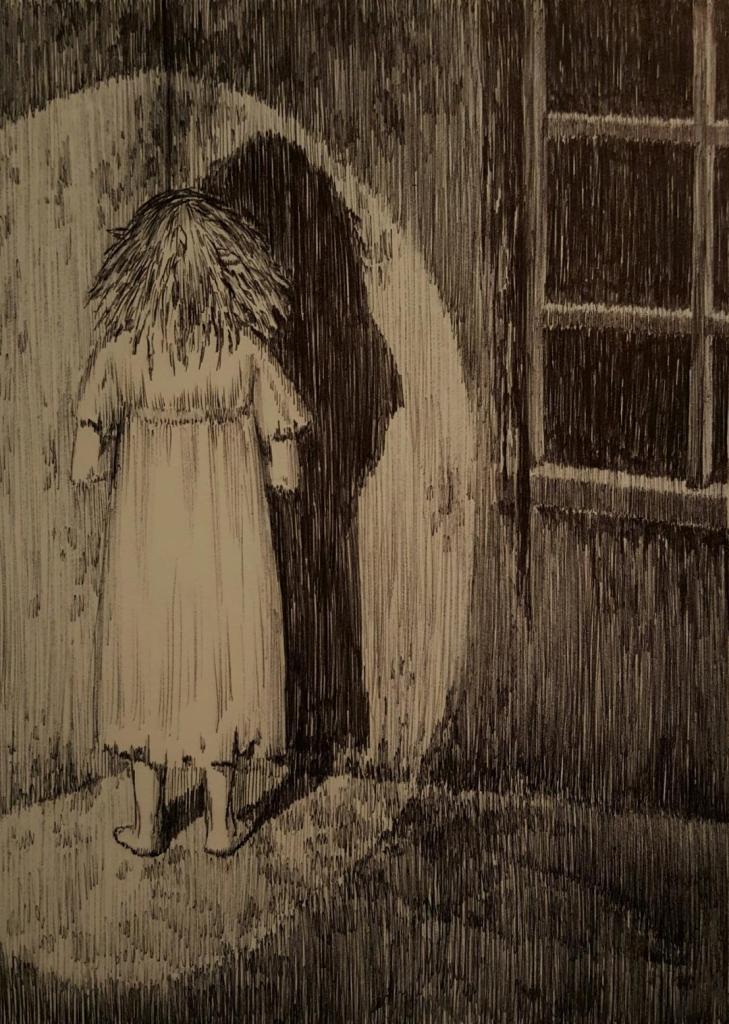
She was standing in the corner with her back to us. Her hair was full of twigs and dead leaves. She wore a long white gown and her feet were bare.
Knock, knock, knock, went the sticks in her hands.
She didn’t stop or turn round. With each percussive blow, her elbows twitched at her sides.
We looked at each other in pleasant confusion, then turned our gaze to the girl.
“Who are you?” Jon marvelled.
“The spirit of the woods,” she said. “You can stay with me forever in this house.”
“Then show us your face,” he urged.
“You don’t want to see it.”
He moved impatiently towards her.
“Yes we do.”
I don’t know how the spell was broken, but I know I wobbled as I stood there. Did we want to?
It was suddenly strange, rather than charming, for the girl to be standing with her back to us. I wondered what she was doing there at all. Before we’d brought our torches, she’d been waiting in the dark. Her bare arms were those of an old woman, even though she had the voice of a girl.
“Show us your face,” said Jon again—reaching out to grab her shoulder. I realised, with a sudden pang of dread, that I didn’t want to see it.
Tim was the first to bolt. Without a word, he turned and fled. Mandy and I followed him through the hall, all the way down the dark stairs. His thumping feet had stirred us from our trance.
Jon didn’t follow.
We heard a bloodcurdling scream behind us. It grew in volume as we exploded through the door and into the night. It followed us through the dark trees, all the way to the river.
We got split up in the dark but managed to find our separate ways home. I remember I came out of the park somewhere in Prestwich, then wandered aimlessly till I found Bury New Road.
In the days that followed, we talked by phone, speaking in low whispers so our parents didn’t hear. None of us could reach Jon. To this day, I have no idea what happened to him. Maybe his parents returned from Burnley to find him missing, but news never reached us, because he’d already left school. It does seem odd that the police wouldn’t speak to his friends, so I like to think he found his way home, and they moved to Accrington as planned.
Later in life, I tried to find him on social media. I never could.
Nor could I find that house again. As an adult, I viewed the whole park on Google Maps. As far as I could see, there was no Georgian manor.
One day, I returned on foot and tried to retrace my steps. Somewhere past the prison and the bridge, I turned my back to the river and went through the trees. After a while, I found the bare foundations of a long-gone building.
I did a bit of reading online. I believe they were the remains of Irwell House. According to Wikipedia, “the house caught fire during a civil defence exercise in 1958 and was demolished some years later. The foundations and the first course of stones were left in place and are still visible today.”
I’ve since found a painting of Irwell House, so I know it was a Georgian manor with sash windows. The doorway was stone, with two pillars and a pediment. It came down years ago, before I was born. The foundations are wild with long grass. Make of that what you will.
I don’t know who the girl was, but I know she isn’t human. Maybe she never was—but she’s out there, somewhere. Even now, she haunts a dark hall in a house that isn’t there, calling children in the night.
When summer comes, I leave a TV on in my bedroom, for fear I’ll hear that knocking again.
One thing remains to be said. When I left Kersal High for the last time, I got the other pupils to sign my school shirt. That was the tradition.
Years later, I found it in the loft and read the messages. One of them surprised me.
I’m still here, someone had written. Come and play. Jon.
I hope it was Tim or Mandy trying to be funny, but in my heart of hearts I know it wasn’t.
 Northwest Horror